- Phone:8618300615001
- Email:info@yfbatt.com


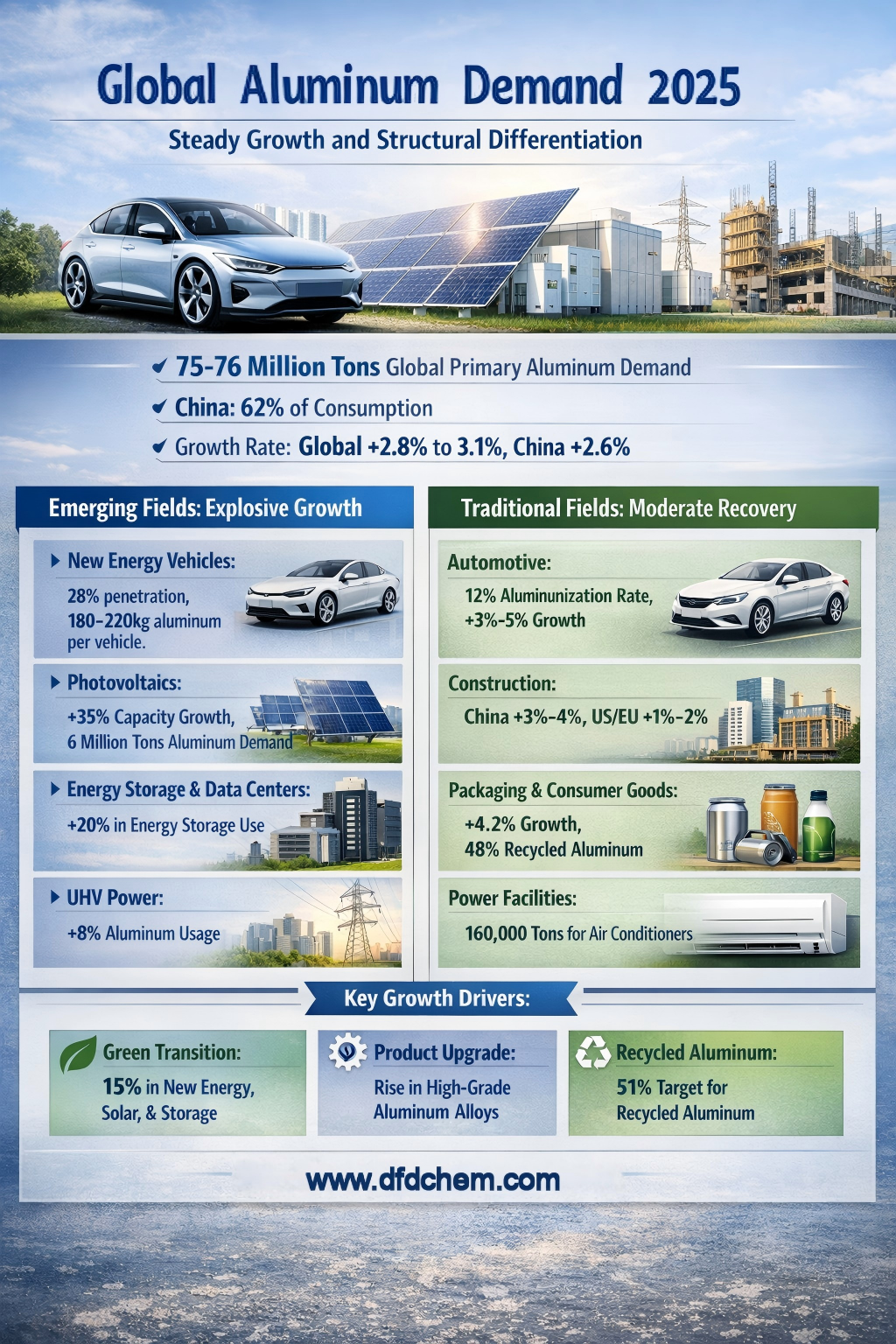
In 2025, the global electrolytic aluminum demand will show the characteristics of "steady growth in total volume and differentiation between new and traditional structures". The global primary aluminum consumption is expected to reach 75-76 million tons, a year-on-year increase of 2.8%-3.1%, and the demand growth rate in China will be about 2.6%. The core driver comes from emerging fields such as new energy, while the traditional fields will recover moderately.
The detailed analysis is as follows:
(I)Overview of Global and Chinese Demand
1. Global Total Volume: In 2025, global primary aluminum consumption is expected to be 75-76 million tons, a year-on-year increase of 2.8%-3.1%. China accounts for about 62%, remaining the world's largest consumer.
2. Chinese Demand: The domestic demand growth rate exceeded expectations to 2.6%, significantly higher than the 1.0% predicted at the beginning of the year. The demand in fields such as new energy vehicles and energy storage exceeded expectations, and the decline in construction aluminum use was smaller than expected.
3. Supply-Demand Pattern: The demand growth rate is higher than the supply growth rate, the market has shifted from a tight balance to a substantial shortage, and inventories are at a historical low.
(II)Demand Analysis by Field
1. Emerging Fields: Explosive Demand Growth (Growth Rate 8%-10%) Field Core Driver Demand Performance New Energy Vehicles Penetration rate reaches 28%, aluminum usage per vehicle is 180-220kg Aluminum usage increases by 5%-8%, and high-purity aluminum demand reaches 4.5 million tons Photovoltaics .Global installed capacity increases by 35% year-on-year, aluminum for frames and brackets accounts for 12% of module costs Aluminum demand increases by 25%, reaching 6 million tons in 2025 Energy Storage and Data Centers Strong demand for energy storage battery casings, AI drives data center construction Aluminum for energy storage increases by 20%, aluminum usage per cabinet in data centers is 1.2 tons, demand increases by 15% UHV Stable power grid investment, construction of transmission lines and substations Aluminum usage increases by 8%
2. Traditional Fields: Moderate Recovery and Structural Differentiation
•Automotive: The aluminumization rate of traditional fuel vehicles increases to 12%, aluminum usage per vehicle is 120-150kg, and the demand growth rate is 3%-5%. The trend of automotive lightweight continues, and the aluminum demand increment for automobiles is expected to be 330,000 tons/530,000 tons in 2026-2027.
•Construction: China shows a steady upward trend (growth rate 3%-4%), aluminum alloy formwork and BIPV (Building-Integrated Photovoltaics) become new growth points; Europe and the United States recover slowly (growth rate 1%-2%); the proportion of construction aluminum drops to 30.5%, and the decline in real estate demand narrows to -6%~-7%. •Packaging and Consumer Goods: The lightweight of food and beverages drives demand growth of 4.2%, the proportion of recycled aluminum increases to 48%, approaching the 51% target, and the demand growth rate is 2%-3%.
•Power Facilities: The "aluminum instead of copper" in air conditioners accelerates, and the aluminum demand increment for air conditioners is expected to be 160,000 tons/150,000 tons in 2026-2027; the growth of power grid investment drives the aluminum demand increment for power grids to be 460,000 tons/380,000 tons in 2026-2027.
(III)Core Logic and Trends of Demand Growth 1.Driven by Green Transition: The proportion of aluminum used in the "Three New Products" (new energy vehicles, photovoltaics, energy storage) reaches 15%, with a growth rate 3-5 times that of traditional fields, becoming the core engine of demand growth. 2.Product Structure Upgrade: The localization rate of 6-series and 7-series aviation-grade aluminum alloys increases, the penetration rate of building aluminum formwork rises from 35% to 50%, with an annual demand increment of more than 2 million tons; the aluminum usage in the low-altitude economy (unmanned aerial vehicles, electric vertical take-off and landing aircraft) exceeds 120,000 tons. 3.Increasing Proportion of Recycled Aluminum: The application of recycled aluminum in fields such as packaging increases, which meets the needs of environmental protection and cost control, and the proportion of recycled aluminum is close to the 51% target.
(IV)Key Influencing Factors 1.Policy Factors: Domestic steady growth policies, new energy subsidies, and the implementation of the carbon market promote the growth of green demand, while restricting new production capacity, exacerbating the tight supply and demand. 2.Cost Factors: The price of alumina gradually returns to a reasonable range, electrolytic aluminum has considerable profits, and enterprises are actively producing, but new production capacity is limited, with a supply growth rate of about 1.6%. 3.Global Economy: Under the global interest rate cut cycle, the window of fiscal and monetary policies opens to boost domestic demand; tariff policies may restrict some exports, but the accelerated energy transition supports demand.
(V)Summary and Outlook The core of electrolytic aluminum demand growth in 2025 lies in the explosion of emerging fields such as new energy, and the moderate recovery of traditional fields provides basic support. In the future, with the acceleration of energy transition, the demand for green aluminum will continue to expand, product upgrading and recycled aluminum substitution will become long-term trends, and the tight supply-demand balance pattern may continue to support aluminum prices.