- Phone:8618300615001
- Email:info@yfbatt.com


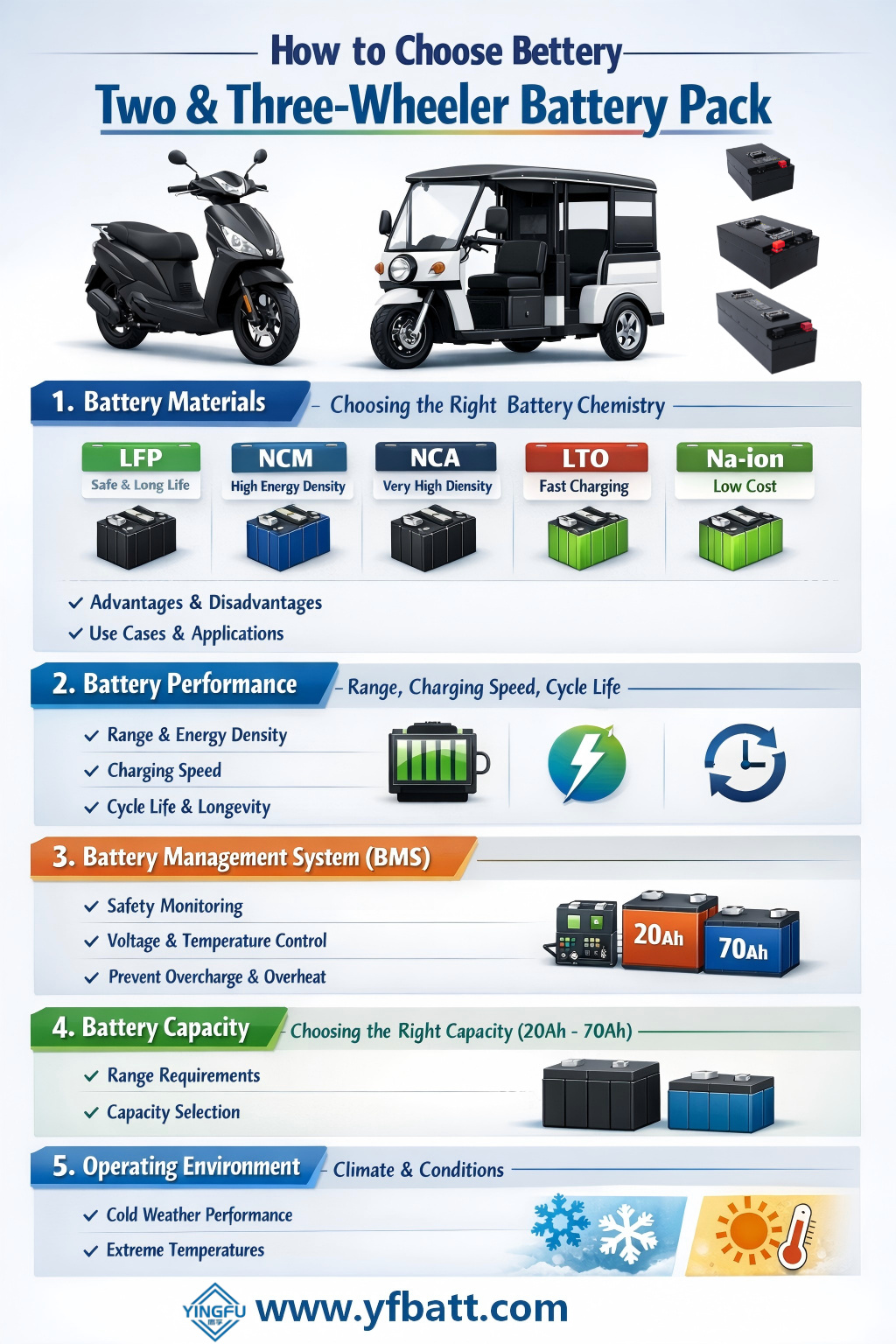
How to choose a battery pack.
Firstly, Battery Materials (Choosing the Right Battery Chemistry)
Different battery chemistries have different advantages. Some common ones include:
1. LFP (Lithium Iron Phosphate) Battery:
Advantages: Very safe, stable, with a long cycle life (4,000-8,000 charge/discharge cycles), good high-temperature tolerance.
Disadvantages: Lower energy density, heavier battery for the same capacity, which may result in shorter range.
Use Cases: Ideal for electric two- and three-wheelers, especially where stability, safety, and long lifespan are needed.
2. NCM (Nickel Cobalt Manganese) Battery:
Advantages: High energy density, provides good power performance, compact, suitable for applications requiring high energy output.
Disadvantages: Relatively expensive, shorter cycle life than LFP.
Use Cases: Suitable for high-performance electric two- and three-wheelers, ideal for longer-distance rides.
3. NCA (Nickel Cobalt Aluminum) Battery:
Advantages: Extremely high energy density, suitable for high-power demands.
Disadvantages: Expensive, sensitive to high temperatures, which can lead to degradation.
Use Cases: Mainly used in premium electric two- and three-wheelers, especially those requiring high power.
4. LTO (Lithium Titanate) Battery:
Advantages: Supports fast charging, performs well in extreme temperatures, long lifespan.
Disadvantages: Lower energy density, higher cost.
Use Cases: Suitable for fast-charging and high-safety applications, such as buses and delivery vehicles.
5. Na-ion (Sodium-ion) Battery:
Advantages: Lower cost, performs well in cold environments.
Disadvantages: Lower energy density, still in the developmental phase.
Use Cases: Suitable for cost-sensitive markets, electric two- and three-wheelers in cold climates.